

History at Eagley Infants
At Eagley Infant School, our History curriculum is designed to inspire curiosity, wonder, and a sense of identity in our youngest learners. We aim to help children understand the world around them, how it has changed over time, and how people’s lives in the past have shaped our community today.
We want children to:
- Develop a strong sense of chronology, beginning with their own personal history and family before exploring significant events and people.
- Recognise similarities and differences between the past and present.
- Build historical vocabulary and use it confidently to describe time, people, and places.
- Develop skills of enquiry, investigation, and critical thinking through stories, artefacts, visits, and discussions.
- Appreciate the history of our local area of Bromley Cross, Bolton, understanding how local events and people have contributed to wider national history.
Ultimately, our intent is to lay the foundations for a lifelong interest in history by fostering curiosity, empathy, and respect for the past.
Our History curriculum follows the EYFS Statutory Framework and KS1 National Curriculum, carefully sequenced to build children’s understanding step by step.
In the Early Years (Nursery & Reception):
- History is taught through the “Understanding the World” area of learning.
- Children explore their own personal history, family traditions, and how they have grown and changed.
- They compare past and present events in their own lives and in the lives of family members.
- Stories, photographs, role play, and artefacts are used to help children develop a sense of time and change.
In Key Stage 1 (Years 1 & 2):
- History is taught through engaging, cross-curricular topics that bring the past to life.
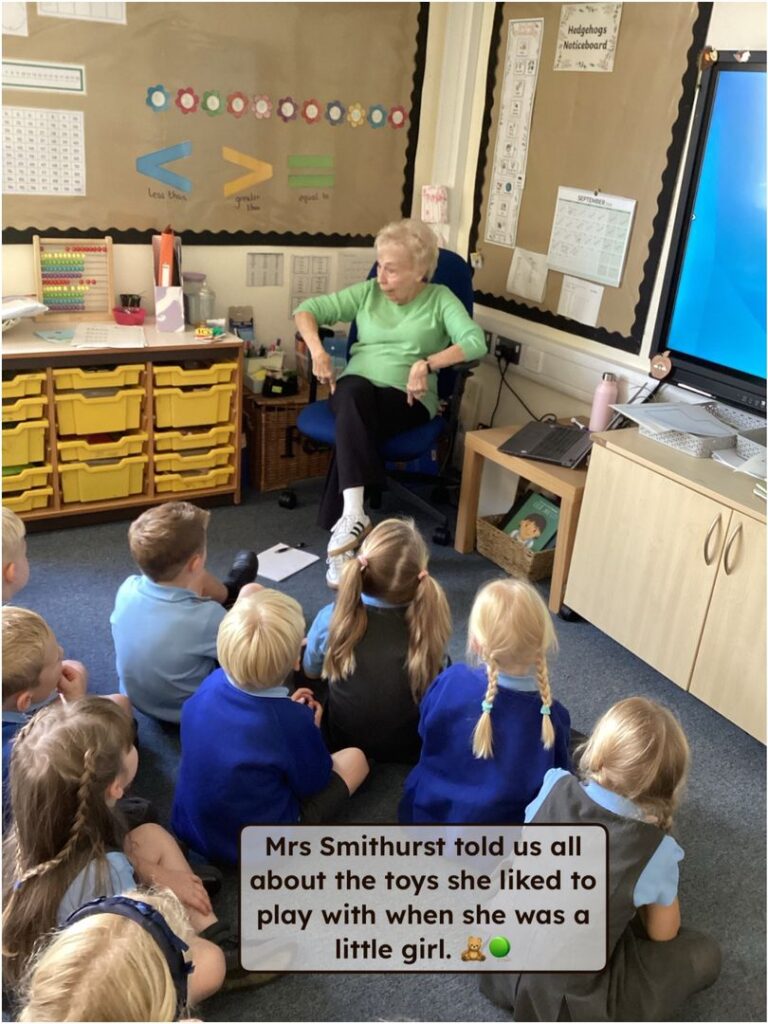
- Pupils study significant people (e.g. In Year 1, Neil Armstrong and Christopher Columbus. In Year 2, Samuel Crompton, Mary Seacole, Florence Nightingale and Edith Cavell), significant events (e.g. The Great Fire of London, Remembrance Day), and local history (e.g. how Bolton has changed over time, local mills, history of toy and farming).
- Lessons build on EYFS foundations by developing children’s understanding of chronology, cause and consequence, and continuity and change.
- Teachers use stories, artefacts, fieldwork, and visits (e.g. to local museums, heritage sites or mills) to deepen understanding and engagement.
- Vocabulary and enquiry skills are explicitly taught and revisited across units.
- Knowledge organisers and visual timelines support children’s recall of key facts and concepts.